
7 Mistakes You're Making with Employee Recognition Awards (and How to Fix Them)
Your employee recognition program is most likely broken, and you don't even know it. 💀
Seriously, if you're still handing out generic plaques at yearly ceremonies and wondering why employee engagement scores keep dropping, you're stuck in the past. While your competitors are building cultures that actually retain top talent, you're confidently burning through budgets on awards programs that make people cringe.
The brutal truth? Most corporate awards programs fail because they're built on outdated assumptions about what actually motivates people. You're not just wasting money: you're actively demotivating the very employees you're trying to recognize.
But here's the thing: fixing these mistakes isn't rocket science. It just requires ditching the "one-size-fits-all" mentality and getting serious about recognition that actually works.
Mistake #1: Your Recognition Criteria Are Mysteriously Vague
"Outstanding performance." "Going above and beyond." "Team player of the year."
Sound familiar? 😔 These meaningless phrases are killing your recognition program's credibility faster than you can say "employee of the month."
When employees can't figure out what specific behaviors or outcomes actually get recognized, your entire program becomes a popularity contest. People start viewing awards as arbitrary handouts rather than meaningful acknowledgment of real achievements.
The Fix: Get ruthlessly specific about what you're rewarding. Instead of "exceptional leadership," try "Sarah increased team productivity by 23% while reducing turnover to zero over six months." Instead of vague teamwork awards, recognize "the cross-functional project that delivered $2M in cost savings three weeks ahead of schedule."
Create clear, measurable benchmarks that connect directly to business outcomes and company values. When employees know exactly which behaviors lead to recognition, they'll start consistently replicating those behaviors.
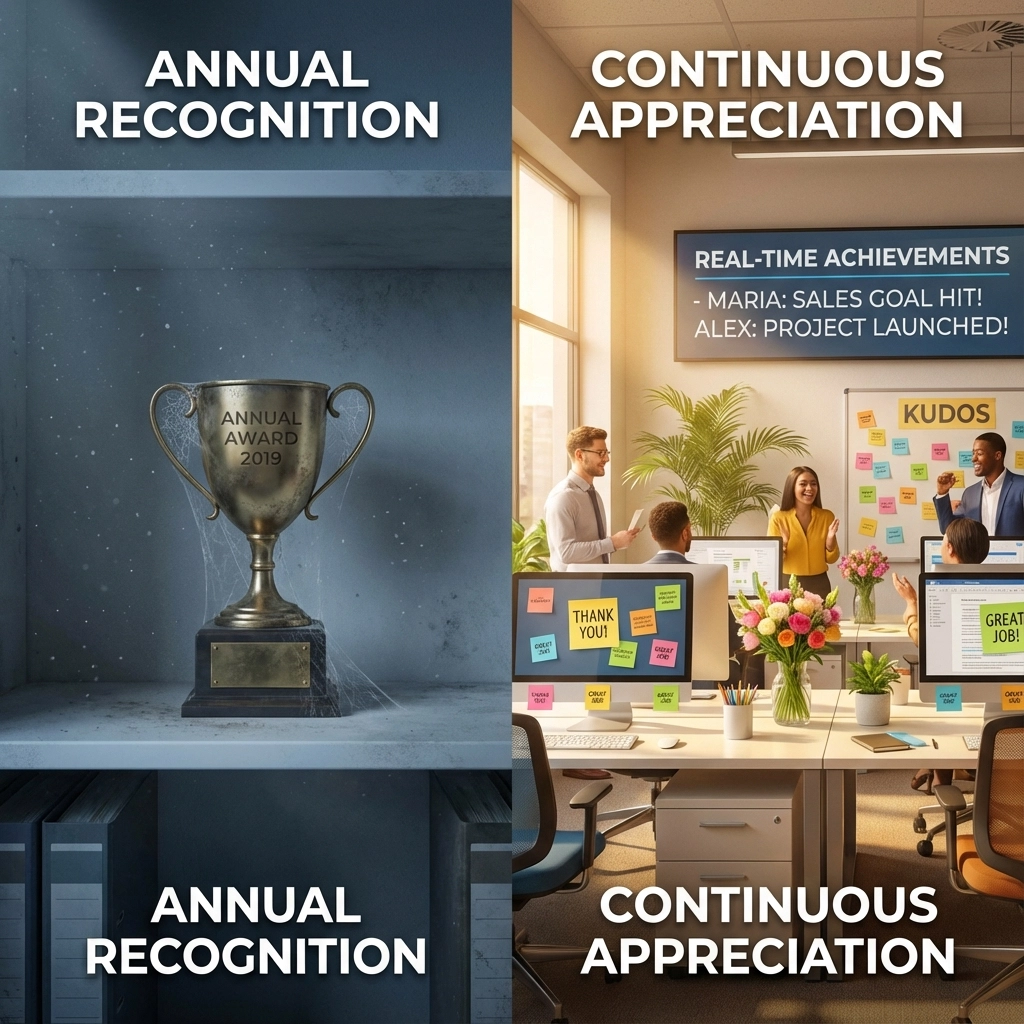
Mistake #2: You're Treating Recognition Like a Once-a-Year Obligation
Annual awards ceremonies are the participation trophies of corporate recognition. 🏆
Think about it: you're asking employees to stay motivated for 365 days based on a single night of appreciation? That's like trying to fuel a car for a cross-country trip with one tank of gas.
The psychological impact of recognition fades within weeks. By the time your next annual ceremony rolls around, last year's award winner has probably forgotten what they even won for.
The Fix: Build recognition into your regular rhythm. Implement weekly team shout-outs, monthly departmental spotlights, and quarterly company-wide celebrations alongside any annual events.
The most effective recognition programs layer frequent, informal appreciation with more formal recognition moments. This creates a constant feedback loop that keeps employees engaged throughout the year, not just during awards season!
Mistake #3: Your Awards Scream "Generic Corporate Nonsense"
Generic gift cards. Identical crystal paperweights. Mass-produced plaques with interchangeable nameplates... 🤮
This isn't recognition: it's corporate laziness with a bow on top.
When recognition feels like it came from a catalog rather than genuine appreciation, employees see right through it. They know you spent exactly zero seconds thinking about them as individuals, and that knowledge undermines the entire gesture.
The Fix: Personalize everything! Learn what actually matters to each team member. Some people want public recognition, others prefer private appreciation. Some value experiences over objects, others want something tangible they can display.
Consider offering choice-based recognition that lets employees select from custom awards, unique experiences, or additional time off. When you're presenting awards, include specific context about what the person accomplished and why it mattered to the organization.
The goal isn't just to give recognition: it's to make people feel genuinely seen and valued.
Mistake #4: You Only Recognize the Obvious Wins
If your recognition program only celebrates top sales performers and project completions, you're missing 90% of the valuable contributions happening in your organization daily.
This narrow focus creates an exclusive recognition club that leaves most employees feeling invisible. The person who mentors new hires, the team member who prevents major problems, the colleague who improves processes: their contributions matter just as much as hitting quarterly targets.
The Fix: Expand your recognition categories. Create awards for collaboration, innovation, problem-solving, continuous learning, and cultural contributions. Recognize the person who makes everyone else's job easier, the team member who embodies company values, or the employee who goes out of their way to help customers.
Some of the most impactful recognition celebrates effort and growth, not just final outcomes. When you recognize someone for taking on a challenging project (even if it didn't succeed perfectly), you're encouraging risk-taking and innovation across your entire organization.
Mistake #5: Your Recognition Program Exists in a Values Vacuum
Here's a question that'll make you uncomfortable: Can employees clearly connect your recognition choices to your stated company values?
If your company claims to value innovation but only recognizes efficiency, or says teamwork matters but exclusively rewards individual achievers, your recognition program is actively contradicting your culture messaging.
The Fix: Audit your recognition program against your company values ruthlessly. Every award, every celebration, every public acknowledgment should directly reinforce what your organization actually stands for.
When presenting recognition, explicitly connect the person's actions to specific company values. "Maria's approach to this client challenge perfectly demonstrates our commitment to creative problem-solving and customer obsession." This alignment makes recognition feel authentic rather than arbitrary.
Your recognition program should be a living demonstration of your company culture, not a separate corporate ritual that exists independently!

Mistake #6: Your Managers Are Recognition Disasters
Most managers give recognition about as naturally as they perform interpretive dance. They default to awkward, generic praise because nobody ever taught them how to deliver meaningful appreciation effectively.
"Good job on that thing" isn't recognition: it's a conversation filler.
Without proper training, even well-intentioned managers turn recognition moments into cringe-worthy experiences that make everyone uncomfortable. Employees can sense when appreciation is forced or formulaic, which completely destroys its motivational impact.
The Fix: Invest seriously in recognition training for all levels of management. Teach the specifics: how to identify recognition-worthy behaviors, how to deliver praise that feels genuine, and how to tailor recognition styles to different personality types.
Train managers to use the S.T.A.R. method: describe the specific Situation, the Task at hand, the Action the employee took, and the measurable Result it produced. This framework transforms vague praise into meaningful, memorable recognition!
Also, teach managers to recognize achievements immediately, not weeks later during formal reviews. Timely recognition has exponentially more impact than delayed appreciation.
Mistake #7: You're Ignoring Team Recognition Completely
Individual recognition is important, but if that's your entire strategy, you're missing out on major opportunities to strengthen collaboration and shared accountability.
Teams accomplish most significant business outcomes, yet most recognition programs are built around celebrating solo performances. This approach can actually undermine teamwork by making colleagues compete for limited recognition opportunities.
The Fix: Build team recognition into your program structure. Celebrate cross-functional collaborations, department-wide achievements, and collective problem-solving efforts with the same intensity you bring to individual awards.
Consider glass or crystal awards ( like these: Art Glass Awards | RS Recognition ) designed specifically for team recognition: something beautiful that can be displayed in common areas where the entire team can take pride in their shared accomplishment.
Team recognition creates a multiplier effect: instead of motivating one person, you're energizing entire groups while reinforcing collaborative behaviors that drive better business results.

The Recognition Program That Actually Works
Effective employee recognition isn't about bigger budgets or fancier award trophies: it's about building systems that make appreciation feel genuine, timely, and connected to what actually matters in your organization.
The companies winning the talent retention game have recognition programs built on clear criteria, frequent appreciation, personalized approaches, and strong alignment with organizational values. They've moved beyond generic corporate awards to create recognition experiences that employees actually value and remember.
Your recognition program should make people excited to contribute, not just go through the motions of appreciation theater.
Ready to transform your recognition program from obligatory corporate ritual into a genuine driver of employee engagement and retention? We'd love to help you identify opportunities to simplify your approach while maximizing impact.
Send your current awards program details to Hello@RSRecognition.com and we'll review everything for potential cost savings and simplification opportunities. No sales pressure: just practical insights on building recognition that actually works!
Comments